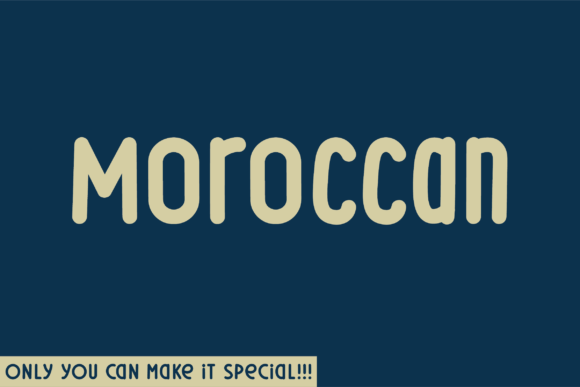
Moroccan Handwritten Font for Crafters & Makers
As a maker who designs printable wall art, hand-stamped tags, and custom wedding stationery, I’ve tested dozens of script fonts—many beautiful, but few truly work across real-world craft projects. Moroccan is different. It’s not just decorative; it’s engineered for authenticity and usability. Because it’s a natural handwritten font—crafted without altering a single node in each character’s indentation—it carries the subtle imperfections and organic flow of real pen-on-paper movement. That small detail makes all the difference when your customer holds a candle label or reads a boutique gift tag.
Why Moroccan Feels Human—and Why That Matters
When you’re building a brand around warmth, intention, or artisanal care, typography sets the emotional tone before a word is read. Moroccan doesn’t shout. It leans in—softly, confidently. Its lowercase letters have gentle entry and exit strokes, its capitals carry quiet elegance, and spacing stays open enough to breathe on physical products like kraft paper labels or matte-finish greeting cards. Unlike over-embellished scripts that get lost at small sizes, Moroccan retains legibility down to 10pt on printed product tags and even smaller on die-cut vinyl stickers (tested on Cricut Explore Air 2 and Silhouette Cameo 4).
Where Moroccan Shines in Your Physical & Digital Products
I use Moroccan across my shop—not as a one-trick accent, but as a consistent voice across categories:
- Candle & soap labels: Paired with a clean sans serif (like Montserrat or Poppins) for ingredient lists, Moroccan adds personality to the brand name or scent title—“Lavender & Sage” looks grounded, not fussy.
- Wedding stationery: It’s my go-to for welcome signs, place cards, and menu headers. The natural rhythm avoids looking overly formal or cartoonish—just warm, personal, and timeless.
- Printable planner pages & digital downloads: Because Moroccan renders crisply at high DPI and exports cleanly from Canva, Illustrator, and Affinity Designer, it holds up in PDF templates sold on Etsy—even when customers resize or layer it over textured backgrounds.
- Tote bags, mugs, and tees: For short phrases (“Good Day”, “Made With Love”, “You Belong Here”), Moroccan’s balanced weight and spacing prevent ink bleed during screen printing or DTG transfers.
- Farmhouse-style signs & seasonal decor: On wood-grain SVGs or laser-cut acrylic, Moroccan’s slight variation in stroke thickness gives depth—no flat, robotic uniformity.
Practical Tips for Cutting, Printing & Pairing
Before sending anything to your cutting machine: always convert Moroccan to outlines in vector software. While it’s a well-hinted OTF/TTF font, outline conversion eliminates any risk of missing glyphs or rendering shifts—especially important for SVG bundles or layered template files. For small stickers (under 1.5”), stick to uppercase words or two-word phrases—“Joy”, “Hello Love”, “Hand-Poured”—and avoid tight kerning adjustments unless you’re manually refining paths.
Font pairing is where Moroccan becomes even more powerful. I almost always pair it with a neutral, highly legible sans serif—never another script. Think of Moroccan as the storyteller and your secondary font as the trusted translator. For example:
- Moroccan + Inter for minimalist printable calendars and digital planners
- Moroccan + Playfair Display for luxury wedding invites (serif contrast adds hierarchy without competition)
- Moroccan + Work Sans for product packaging where clarity and approachability both matter
Avoid pairing Moroccan with ultra-thin or overly geometric fonts—they clash with its tactile warmth. And skip stacking multiple script fonts; Moroccan already carries expressive weight on its own.
Licensing, Formats & Real-World Readiness
Moroccan is part of the Script Amp collection—a curated group of fonts built specifically for makers who sell physical goods and digital assets. It includes standard OpenType (.OTF) and TrueType (.TTF) files, full multilingual support (including extended Latin characters), and basic OpenType features like stylistic alternates and discretionary ligatures—useful if you want subtle variations in repeated words like “forever” or “together” on wedding signage.
Crucially, the commercial license covers exactly what you need: selling printed invitations, cut vinyl decals, embroidered patches, SVG files for Cricut users, Canva templates, printable wall art, and even client work for local boutiques. No extra fees for unlimited physical units or digital downloads—as long as you’re not reselling the font file itself.
Not Just Pretty—Purposefully Designed
What sets Moroccan apart isn’t just how it looks—but how it behaves. It’s a display font that doesn’t sacrifice readability. A handwritten font that doesn’t rely on excessive swashes to feel authentic. A premium typeface that works as hard on a $3 sticker as it does on a $95 wedding suite. In a market flooded with trend-driven fonts, Moroccan feels like a quiet, confident choice—one that grows with your shop instead of dating your designs.
If you’ve hesitated to use script fonts because they looked too fragile, too busy, or too inconsistent across formats—give Moroccan a test run on your next product mockup. Type out your shop name. Try it on a kraft tag preview. Drop it into a Canva social post. You’ll feel the difference right away: not flash, but presence. Not noise, but voice.